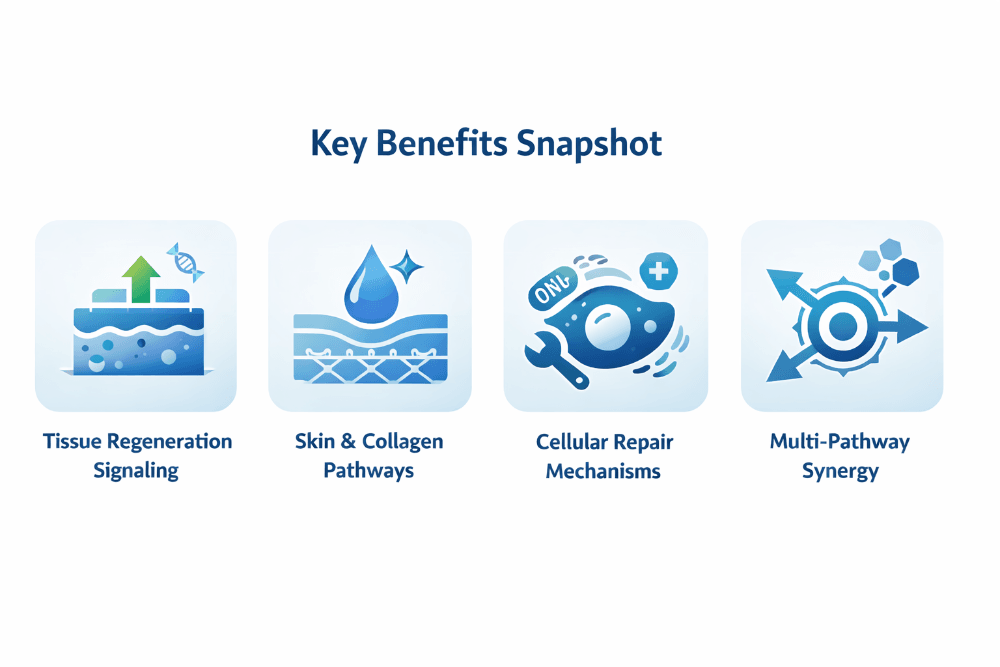
If you’re new: this is the “why it matters” section. GLOW is designed to explore how multiple repair-related pathways can overlap in a coordinated way.
What is the GLOW peptide protocol? GLOW is a research-oriented multi-peptide framework combining
GHK-Cu (a copper-binding peptide studied for tissue remodeling signals),
BPC-157 (studied for cytoprotective and repair signaling in preclinical models),
and TB-500 (a thymosin beta-4 fragment studied for cell migration and tissue repair coordination).
It’s popular because it reflects a “systems” approach instead of betting everything on one signal.
What GLOW Is (and What It Isn’t)
Let’s keep this clean. Online you’ll see two extremes: hype like it’s magic, or people calling everything fake.
Reality sits in the middle: peptides can be useful research tools, but you have to talk about them with strict boundaries.
CoreVionRX stance: This article is education and research discussion only. Not medical advice, not a treatment plan, not a promise. These compounds are not FDA-approved therapies for human use.
The GLOW protocol is best understood as a framework:
a structured way to think about how separate signaling domains may overlap:
(1) tissue remodeling signals, (2) inflammatory signaling, (3) cellular migration/repair coordination, and
(4) collagen-related pathways and extracellular matrix organization.
Quick definitions (beginner friendly)
GHK-Cu: a copper-binding tripeptide studied for gene expression modulation and tissue remodeling signaling.
BPC-157: a synthetic peptide studied in preclinical models for cytoprotective and repair signaling (tissue integrity contexts).
TB-500: a thymosin beta-4 fragment studied for cellular migration, actin regulation, and repair coordination pathways.
Why Multi-Peptide Systems Became the Default (Biohacker Logic)
Here’s the honest explanation: stacking is an attempt to reduce bottlenecks.
If one signal relates to cellular migration and another relates to remodeling organization, the “systems” idea is:
overlapping signals might create a more complete environment than a single signal alone.
The “single-signal” problem
Even if a single compound triggers a repair-related signal, the system can still be limited by inflammation, ECM structure, mobility, or recovery constraints.
That’s why results can be inconsistent when people chase one magic ingredient.
The “systems” hypothesis
A coordinated set of signals can theoretically create a better overall environment for repair processes.
Not a guarantee — just a more interesting research question: “What changes when multiple signals overlap?”
Mechanisms & Synergy Logic (Clean Version)
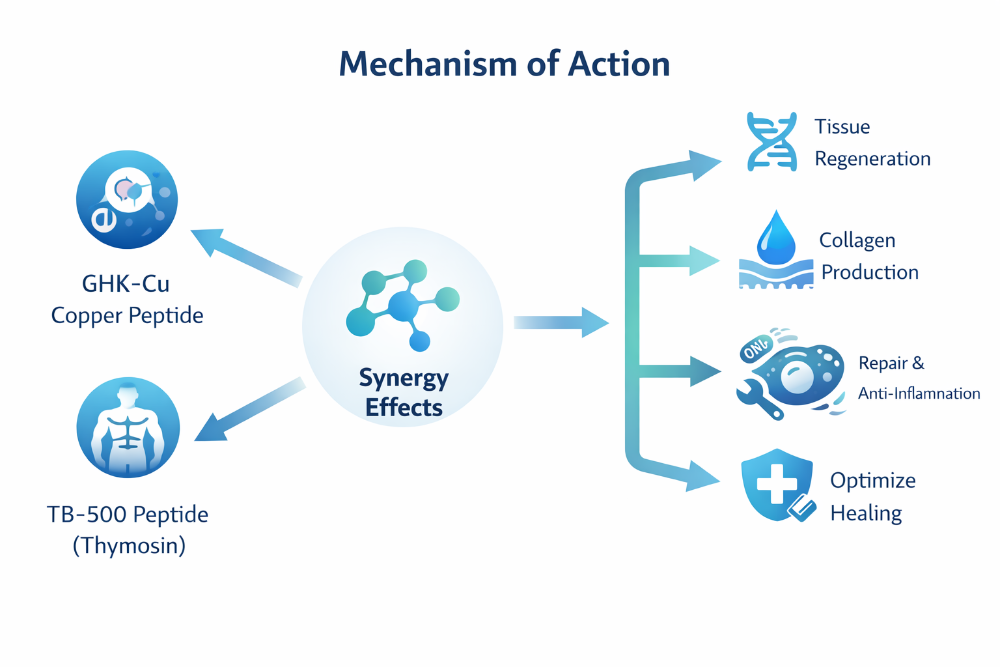
Simplified pathway role model. Educational diagram, not a clinical claim.
1) GHK-Cu: remodeling signals + copper context
GHK-Cu gets labeled “skin peptide” online, but that’s a lazy shortcut. The research interest comes from how copper-binding peptides may influence
remodeling-related signaling and how copper context intersects with collagen pathways and gene expression signals in cell models.
BPC-157 is widely discussed because preclinical research explores it in models where tissue integrity and repair signaling are being investigated.
The clean framing: it’s studied in scenarios tied to protective/cytoprotective signaling and tissue stress contexts.
3) TB-500: migration + coordination logic
TB-500 is commonly discussed around cell migration, actin-related dynamics, and repair coordination (thymosin beta-4 fragment research).
The reason it’s popular in stacks is simple: repair requires organization and movement, not just “growth.”
Direct Answer (AEO): GLOW’s synergy concept is that each peptide maps to a different “layer” of the repair conversation:
GHK-Cu (remodeling/collagen signaling context), BPC-157 (tissue integrity & protective signaling in models), TB-500 (migration/coordination logic).
Overlap can be more complete than a single-signal approach.
Peer-reviewed starting points people cite in these discussions:
Quality, Sourcing & How to Read a COA (Without Getting Played)
Real talk: most problems come from contamination, mislabeling, bad handling, or fake COAs.
If you care about results, you should care about proof.
What a real COA typically includes
Identity confirmation
Look for mass spectrometry (MS) or equivalent. Purity without identity can still be the wrong compound.
Purity testing
HPLC purity is common. Real reports show method details + sample ID + chromatogram—not just a number.
Batch specificity
COA should be batch-specific. If the vendor reuses the same COA, treat it as marketing.
Red flags
No lab name, no method, no sample ID, no date.
“99.9%” for every peptide, every time.
No handling or storage guidance.
Dodging questions about test methodology.
Reality: The best marketing is a clean COA from a credible third-party lab with real metadata. Everything else is noise.
Risk Framing & Logic (Research-First, Not Hype)
The internet loves “side effects lists,” but most lists are trash because they mix animal data, anecdotes, and guesses.
Correct way to think about this: uncertainty management. Unknown isn’t automatically “safe” or “danger.”
These compounds appear in research communities and preclinical literature.
Human-quality clinical outcome data is limited for many online use-cases.
Risk is dominated by sourcing + handling quality, not just the molecule.
Online content is not a substitute for a qualified clinician.
Compliance: CoreVionRX products are intended for research and educational purposes only. Not for human consumption.
How Researchers Design a Protocol (Without Turning It Into Bro-Science)
People always ask “what’s the dose?” — but that’s where online content turns messy fast.
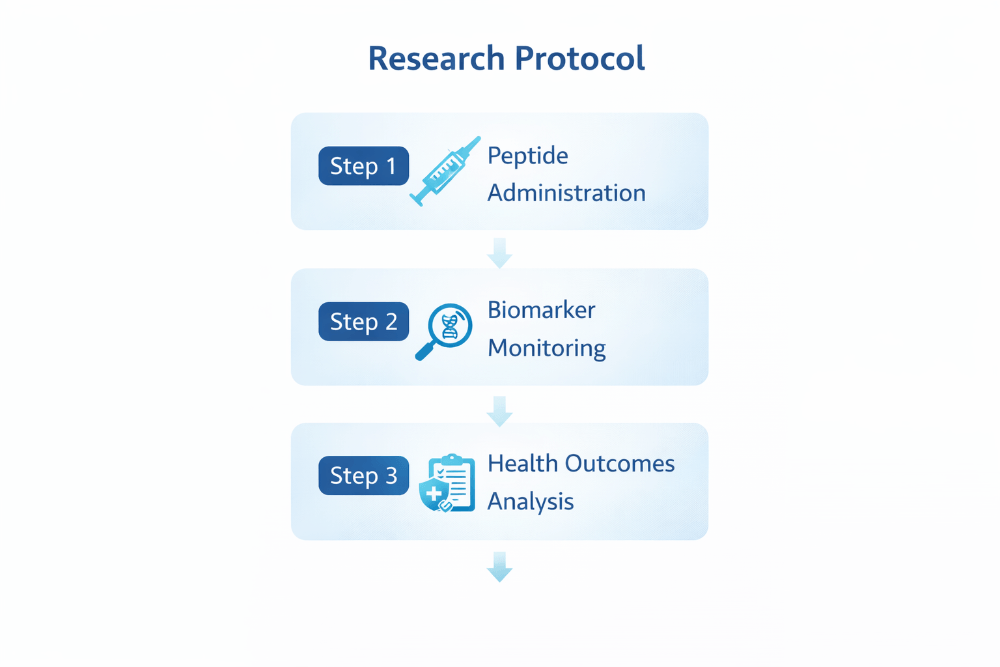
Better question: what variables are controlled, and what outcomes are measured?
Beginner model: Learn the basics first: COA, batch, stability, storage, and what “research-only” actually means.
Start with one clear research goal (skin remodeling signals vs recovery observation, etc.).
Track 2–3 consistent markers instead of 20.
Don’t change five variables at once — you learn nothing.
Pro move: use this same product card component across all peptide articles so the UX stays uniform.
Note: This article is educational. Product availability/pricing can change. Always refer to the product page for canonical details.
FAQ (Clear, Snippet-Ready)
GLOW is a research-oriented multi-peptide framework that combines GHK-Cu, BPC-157, and TB-500 to explore
overlapping signaling roles as a systems approach rather than a single-signal approach.
The combination reflects a synergy hypothesis: each peptide maps to a different layer of the “repair conversation”
(remodeling/collagen context, tissue integrity signaling in models, and cellular migration/coordination logic).
No. This is research-only education. These compounds are not FDA-approved therapies for treating disease.
This article is not medical advice.
Batch-specific COAs with method details, identity confirmation (often MS), credible HPLC reporting,
and documentation of handling/storage. Most bad outcomes come from contamination, mislabeling, or fake testing.
Define one goal, track a small number of consistent markers, avoid changing multiple variables at once,
and prioritize quality/documentation over hype.
Disclaimer!
All products on this website are to be used strictly only for research purposes.
The products on this website must not be used for: (1) human or animal consumption; or (2) diagnosing, treating, curing, or preventing any disease.
By clicking Agree, you confirm:
(1) you are at least 21 years of age; (2) you are a qualified researcher;(3) you will not use these products for human or animal consumption;(4) you accept full responsibility for compliance; and (5) if you buy any products from the website, you will comply with Terms of Service that is available on the homepage of the website.